Land Title as a Financing Prerequisite:
A Developer’s Framework for ALTA Series 36 Endorsement Readiness
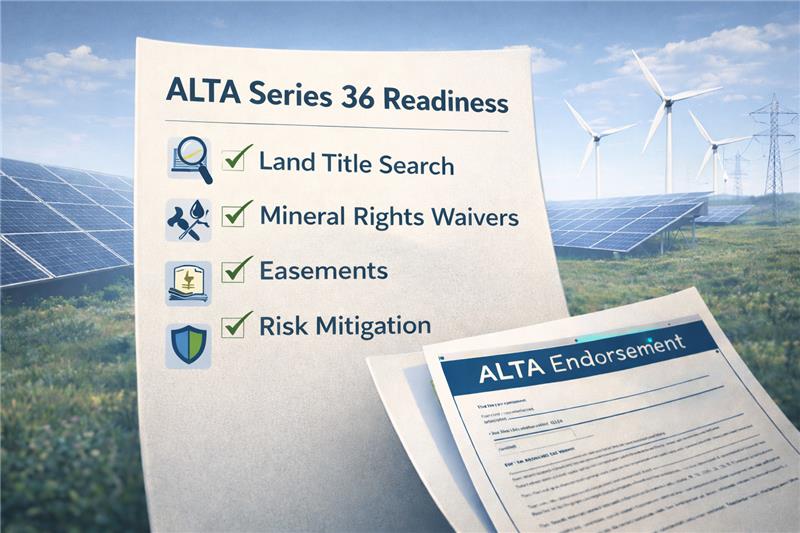
Prepared for energy developers, land acquisition teams, project finance counsel, and title professionals engaged in utility-scale solar, wind, and transmission projects across the United States.
1. Executive Summary
Utility-scale energy projects present title insurance challenges that standard commercial policies were never designed to address. The American Land Title Association (ALTA) began adopting its Series 36 energy endorsements on April 2, 2012 to close critical coverage gaps for electricity generating facilities, specifically the mismatch between personal property improvements (turbines, panels, racking systems) and the real property interests actually insured under base-form policies. With over 1,085 GW of solar capacity sitting in U.S. interconnection queues as of year-end 2023, and historically only 10% of that requested capacity ultimately getting built, the financing process has become the single most consequential bottleneck in the development pipeline. A clean title pro forma with properly structured Series 36 endorsements is not a closing formality. It is the document that lenders and tax equity investors scrutinize before committing capital. This case study examines how the Series 36 works, where projects fail to meet its requirements, and what land teams can do to prevent financing delays rooted in title deficiencies.
2. Introduction / Problem Statement
Consider the basic economics of a utility-scale wind project: a 150 MW facility with a total development cost of $220 million, financed through $150 million in project debt and a $50 million tax equity investment, leaving $20 million of developer equity. The turbines, towers, collection system, and substation equipment account for well over 90% of total project costs. Yet under a standard ALTA owner’s or loan policy, these components are almost certainly classified as personal property. The policy insures real property. It does not insure personal property. This means a lender writing a $150 million construction loan is staring at a title insurance policy that, absent specific modifications, covers a fraction of what it is lending against.
That problem compounds when you layer in the site-control complexity typical of these projects. A single wind or solar development might span dozens of parcels, mixing fee acquisitions, ground leases, easements for access roads, transmission interconnection corridors, and collector line routes. Each parcel carries its own chain of title, its own encumbrances, its own mineral reservations. Before Series 36 existed, developers had to negotiate custom policy modifications on a deal-by-deal basis, often burning weeks of closing timeline while underwriters tried to adapt standard commercial endorsements to situations they were never intended to cover.
The stakes have only intensified since 2012. According to Berkeley Lab’s 2024 edition of its Utility-Scale Solar report, 18.5 GW of new utility-scale PV capacity came online in the U.S. during 2023 alone, bringing cumulative installed capacity above 80.2 GW across 47 states. Globally, the wind and utility-scale solar pipeline surpassed 4.9 TW in 2025, per the Global Energy Monitor. Every one of these projects touches a title pro forma at some point. The question is whether that pro forma will satisfy the financing parties, or whether it will become the reason financial close slips by months.
3. Technical Deep Dive: The Series 36 Architecture
The ALTA Series 36 is a suite of endorsements purpose-built for electricity generating facilities, including wind farms, solar farms, and conventional generation. These endorsements were initially adopted effective April 2, 2012, with the fee estate endorsements (36.7/36.8) added in 2014 and ALTA 36.9 becoming effective January 2, 2025. The architecture is organized around two axes: the type of real property interest being insured, and whether the policy is an owner’s or loan policy.
3.1 Estate-Specific Endorsements
The primary endorsements are the estate-specific forms: ALTA 36/36.1 (leasehold and easement interests), ALTA 36.2/36.3 (leasehold only), and ALTA 36.7/36.8 (fee estate). Each pair consists of an owner’s policy form and a loan policy form. The availability of each depends on two factors: what combination of leasehold, easement, and fee interests make up the project’s real estate footprint, and whether the insured party is the project owner or the project lender.
These endorsements accomplish two things that standard policies do not. First, they modify the valuation methodology so that the title company assesses loss or damage by treating individual parcels as components of a broader, integrated project. If a title defect surfaces on one constituent parcel, the underwriter will consider consequential losses across the entire project footprint. Without this endorsement, a covered claim on a single parcel among thirty would only produce recovery for the value of that one parcel, ignoring the reality that losing the parcel could cripple the interconnection layout for the whole facility.
Second, the endorsements introduce the concept of “Severable Improvements,” covering property affixed to the land that would constitute an Electricity Facility but for its characterization as personal property. In the event of an eviction, the calculation of loss includes the diminution in value of any Severable Improvements, reduced by salvage value. This directly addresses the core problem: the gap between the insured real property and the personal property improvements that comprise the overwhelming majority of project value.
3.2 Supplemental Endorsements
Beyond the estate-specific forms, the Series 36 includes ALTA 36.4/36.5 (CC&R coverage for land under development), ALTA 36.6 (encroachments), and the most recent addition, ALTA 36.9 (minerals and other subsurface substances for land under development), which became effective January 2, 2025. The 36.6 encroachment endorsement insures against loss from encroachment of the electricity facility or severable improvements onto neighboring land or into pre-existing easements, and from encroachments by neighboring property onto the insured land. In practice, this endorsement typically requires a thorough ALTA survey and a meticulous review of all easements of record, including blanket utility easements whose recorded descriptions may not conform to modern surveying standards.
The 36.9 endorsement warrants particular attention from developers working in states with severed mineral estates. It provides coverage against loss from enforced removal or alteration of an Electricity Facility or Severable Improvement resulting from the future exercise of surface rights for mineral extraction. It was designed to replace the prior reliance on a combination of ALTA 35-series mineral endorsements and the ALTA 31 Severable Improvements endorsement, neither of which was tailored to the specific risk profile of an energy project.
3.3 Underwriting guidelines
Title companies often classify energy projects as extra-hazardous risks. Some major national underwriters require that issuance of Series 36 endorsements be approved by an Associate Senior Underwriter or Senior Underwriter. The underwriting criteria are rigorous: insurers typically review an ALTA survey, a set of plans and specifications for the project, and in many cases a mineral report and surface waivers.
State-by-state variation adds friction. Texas, which does not use standard ALTA forms, only recently adopted its own versions of the estate-specific endorsements under a new T-55 series, along with a T-19.4 endorsement modeled on ALTA 36.9. But Texas did not adopt the 36.4, 36.5, or 36.6 equivalents. Developers in Texas still need to request T-19/19.1 endorsements and negotiate express coverage for encroachments over certain easements. Any national-scale development portfolio must account for these jurisdictional differences parcel by parcel.
4. Real-World Context
A stronger real-world warning is United States v. Osage Wind, LLC, one of the most consequential split-estate cases in U.S. energy development. Osage Wind leased roughly 8,400 acres of surface rights in Osage County, Oklahoma to build an 84-turbine, 150 MW wind project, but it did not obtain a federal mineral lease covering the Osage mineral estate held in trust for the Osage Nation. During construction, the developer excavated rock, crushed and reused it as structural backfill for turbine foundations, and the Tenth Circuit held that those activities constituted mineral development requiring a lease. On remand, the district court found liability for conversion and trespass in December 2023. In December 2024, the court issued its final judgment ordering removal of the project by December 2025 and restoration of the site. Enel estimated the dismantling cost at approximately $259 million to $300 million. Even though execution was later stayed pending appeal, the case is a stark reminder that mineral-rights diligence is not a technicality - it can become a project-level catastrophe.
Osage is an extreme example, but the underlying risk is not unusual. Title curative work on large energy projects routinely uncovers similar complications: expired option agreements whose legal descriptions no longer match current survey data, blanket utility easements recorded decades ago with no precise location, severed mineral interests fractionally owned across generations of heirs who may be untraceable. A single missing surface waiver from a minority mineral interest holder can cause a title company to except the mineral risk from coverage, and that exception can be enough for a lender to pull the financing commitment.
Consider a hypothetical 300 MW solar project in West Texas spanning 45 parcels, a mix of fee-owned land and ground leases with separate easements for gen-tie lines and access roads. The mineral estate has been severed from the surface on 28 of those parcels, with fractional mineral interests split among dozens of descendants of the original patent holders. The developer needs ALTA 36/36.1 endorsements for the leasehold/easement parcels, ALTA 36.7/36.8 for the fee parcels, the Texas T-19.4 endorsement (the state’s 36.9 equivalent) for mineral protection, and T-19/19.1 endorsements since Texas did not adopt the 36.6 encroachment coverage. The underwriter requires a mineral ownership report for every severed parcel, surface waivers from a sufficient percentage of mineral holders, and an ALTA survey matching the legal descriptions in the lease and easement agreements.
If three of those 28 parcels have mineral owners who cannot be located, the title company must decide whether to insure around those interests based on factors like how long ago the minerals were reserved, whether there has been any recent production activity in the area, and whether applicable dormant mineral statutes or accommodation doctrines provide a legal basis for coverage. Each of those decisions requires Senior Underwriter approval. Each takes time. And time, in project finance, converts directly into cost overruns and missed ITC/PTC qualification deadlines.
5. Actionable Recommendations
Order title commitments at the LOI stage, not at the financing stage. The number one driver of preventable title delays is late ordering. Title searches, mineral ownership reports, and ALTA surveys take weeks to procure. Curative work can take months. If a developer waits until a lender sends its closing checklist to begin, the project has already lost. Every parcel should have a preliminary title report in hand before the developer enters term sheet negotiations with financing parties
Align ALTA survey boundaries with legal descriptions in every site-control agreement. Mismatches between the legal description in a lease, the legal description in the title commitment, and the ALTA survey are the most common source of curative rework on energy deals. These three documents must be reconciled before the title company will issue the estate-specific endorsement.
Engage the underwriter early on mineral risk strategy. In states with widespread mineral severance (Texas, Oklahoma, North Dakota, parts of the Western U.S. where federal patents commonly reserved mineral rights), developers should initiate mineral ownership reports and begin surface waiver outreach during early-stage development. Do not assume that a “sufficient percentage” of surface waivers will be obvious. The threshold varies by underwriter, by project, and by jurisdiction. There is no industry-wide standard.
Build the title pro forma as a living document. The pro forma is the single artifact that lender counsel, tax equity counsel, and the title company all rely on. It should be updated iteratively as curative work clears exceptions, as surveys are recorded, and as endorsement negotiations advance. Treat it like a project schedule, not a static deliverable.
Know the jurisdictional endorsement landscape. Not every ALTA 36 series endorsement is available in every state. Texas’s recent adoption of the T-55 series was a significant step forward, but the state still lacks equivalents for 36.4, 36.5, and 36.6. Developers working across multiple states must maintain a current matrix of available endorsements and required substitutions for each jurisdiction.
Verify that the Amount of Insurance reflects aggregate project value. The Series 36 endorsements are typically issued with an Amount of Insurance that includes the full value of the land or leasehold, the Electricity Facility, Severable Improvements, and insured easements. If the Amount of Insurance only reflects raw land value, the endorsement is functionally useless to a lender whose collateral package encompasses the entire project.
6. Key Takeaways
- The ALTA Series 36 endorsements exist because standard title insurance policies do not cover the personal property improvements (turbines, panels, collection systems) that represent the vast majority of an energy project’s value. Without them, lenders and tax equity investors face an insurable gap that can render the collateral package unacceptable.
- The integrated-project valuation approach is the most consequential feature of the estate-specific endorsements. It ensures that a title defect on one parcel triggers coverage calibrated to the impact across the entire facility, not just the value of that single parcel.
- Mineral severance is a persistent and underestimated risk. The January 2025 adoption of ALTA 36.9 gives developers a purpose-built tool for mineral protection, but it typically requires mineral ownership reports, surface waivers, and Senior Underwriter approval to issue.
- State-level variation is real and operationally significant. A multi-state development portfolio must account for the fact that Texas, for example, uses T-55 series equivalents and lacks coverage for certain supplemental endorsements that are standard in ALTA states.
- Title curative work belongs in early-stage development, not in the weeks before financial close. The difference between a six-week delay and a deal-breaking delay is almost always a function of when the developer started.
Sources
Cox, Castle & Nicholson LLP. Understanding Title Insurance for Renewable Projects: The 36 Series. https://www.coxcastle.com/publication-understanding-title-insurance-for-renewable-projects-the-36-series
McGuireWoods LLP. Texas’ Adoption of ALTA Endorsements Gives Energy Projects Greater Title Coverage (Feb 2025). https://www.mcguirewoods.com/client-resources/alerts/2025/2/texas-adoption-of-alta-endorsements-gives-energy-projects-greater-title-coverage/
American Land Title Association (ALTA) Policy Forms and Related Documents https://www.alta.org/policy-forms/
National Law Review / Troutman Sanders. New Title Insurance Designed Specifically for Energy Projects https://natlawreview.com/article/new-title-insurance-designed-specifically-energy-projects
American Bar Association. Solar Basics for the Real Estate Practitioner (May/June 2018). https://www.americanbar.org/groups/real_property_trust_estate/publications/probate-property-magazine/2018/may-june-2018/solar-basics-the-real-estate-practitioner/
Stoel Rives LLP. Solar Project Property Rights: Securing Long-Term Land Control. https://www.stoel.com/insights/reports/the-law-of-solar/solar-project-property-rights-securing-your-place
Lawrence Berkeley National Laboratory. Utility-Scale Solar, 2024 Edition. https://emp.lbl.gov/publications/utility-scale-solar-2024-edition
Global Energy Monitor. Global Wind and Solar 2025: The G7 Gap (Feb 2026). https://globalenergymonitor.org/report/global-wind-and-solar-2025-the-g7-gap/
Foley & Mansfield / FBM. Achieving Compatibility Between Solar Project Developers and Mineral Estate Holders. https://www.fbm.com/publications/achieving-compatibility-between-solar-project-developers-and-mineral-estate-holders/
Davis Graham LLP. Case Update: United States v. Osage Wind, LLC. https://davisgraham.com/news-events/case-update-united-states-v-osage-wind-llc/
U.S. Department of Justice / U.S. Attorney's Office for the Northern District of Oklahoma. Enel Ordered to Remove Osage Wind Farm After More Than Ten Years of Litigation (Dec 2024). https://www.justice.gov/usao-ndok/pr/enel-ordered-remove-osage-wind-farm-after-more-ten-years-litigation
United States Court of Appeals for the Tenth Circuit. United States v. Osage Wind, LLC, 871 F.3d 1078 (10th Cir. 2017). https://law.justia.com/cases/federal/appellate-courts/ca10/15-5121/15-5121-2017-09-18.html
This case study is intended for educational purposes and does not constitute legal advice. Developers should consult qualified title counsel for project-specific guidance.
© Volt Title Services. All rights reserved.