How Mineral Rights Conflicts Can Dismantle a Renewable Energy Project

Technical Reference for Land Acquisition Teams and Project Developers in the Utility-Scale Solar, Wind, and Transmission Sectors
Executive Summary
Mineral rights severance, the legal separation of subsurface mineral estates from surface estates, is one of the most underestimated and systematically mismanaged title risks in utility-scale renewable energy development.
Lyle v. Midway Solar, LLC , 618 S.W.3d 857 (Tex. App. El Paso 2020), became the first Texas appellate decision to directly apply the accommodation doctrine to a conflict between a severed mineral estate owner and a solar lessee. While Midway Solar prevailed on procedural grounds, the court left the Lyles' dominant estate claim fully intact, deferred only until Lyle takes active steps toward mineral development.
For land acquisition teams operating in split-estate jurisdictions such as Texas, New Mexico, Wyoming, Colorado, Montana, the lesson is unambiguous: a signed solar lease from the surface owner, without executed mineral subordination from every fractional mineral interest holder, is not a closed transaction. It is a contingent liability with a pending trigger date.
This case study examines the legal mechanics of that risk, quantifies its impact on project finance and closing timelines, and maps each mitigation action directly to the title services, curative workflows, and technology platform that Volt Title Services has built to address it.
Introduction
ERCOT's interconnection queue as of mid-2024 carried more than 300 GW of solar and wind projects awaiting study in Texas alone. Lawrence Berkeley National Laboratory's Queued Up (2024) report documented over 2,600 GW of generation and storage capacity sitting in queues nationally, the overwhelming majority being solar, wind, and battery storage. Behind every megawatt sits a parcel of land, and behind every parcel sits a title history that may stretch back generations: homestead grants, railroad land patents, federal mineral reservations, and decades of oil and gas leasing activity executed long before anyone imagined a solar array would occupy that same surface.
The doctrine of mineral severance which is entrenched across the Permian Basin, the Mountain West, Appalachia, and the Gulf Coast, means the surface rights to a tract and its underlying mineral estate are frequently owned by entirely different parties. A landowner may execute a solar lease with complete good faith, genuinely believing they control everything they are conveying. But if the mineral estate was severed from the surface title in 1948, as it was in Lyle, what was just conveyed to the developer is a fundamentally encumbered asset.
The problem is compounded by a structural failure that has been identified as another common cause of project risk: complex, multi-parcel energy transactions pushed through standard workflows that were never designed for them. The result is friction, missed requirements, and unresolved title defects discovered at exactly the wrong moments like NTP, financial close, and sell-down.
Technical Deep Dive
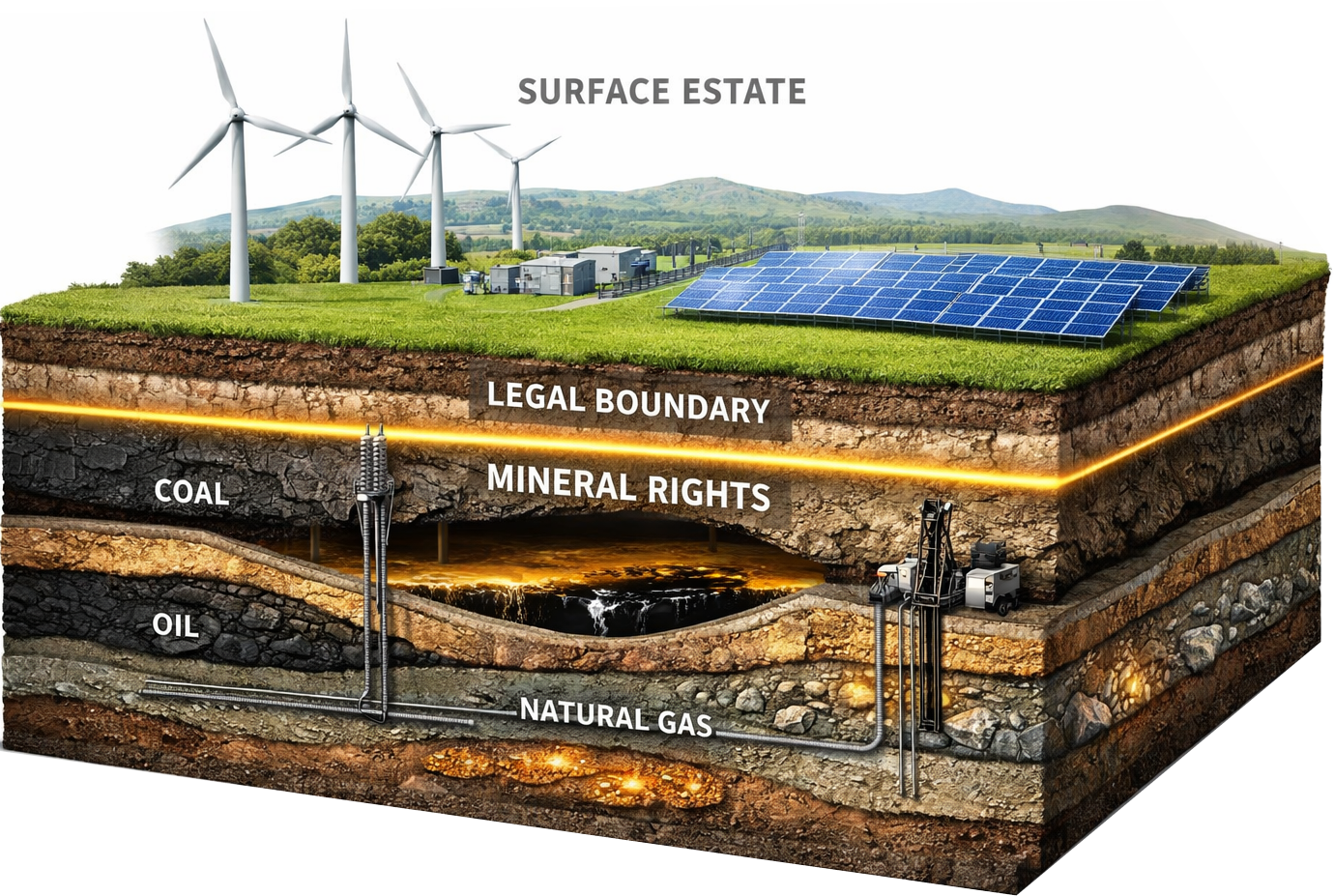
The Dominant Estate and the Accommodation Doctrine
Under Texas law, and in substantially similar form across New Mexico, Wyoming, Colorado, Oklahoma, and Montana, the mineral estate is dominant over the surface estate. The mineral owner or their lessee holds an implied easement to use as much of the surface as is reasonably necessary to develop the minerals, without owing compensation to the surface owner. This right is not passive. It is an active legal entitlement that survives any solar or wind lease the surface owner subsequently executes.
The accommodation doctrine, first articulated by the Texas Supreme Court in Getty Oil Co. v. Jones, 470 S.W.2d 618 (Tex. 1971), softens, but does not eliminate, that dominance. Under Getty Oil, if a surface owner can demonstrate (1) an existing use that would be precluded or substantially impaired by the mineral owner's operations, and (2) that reasonable alternative methods exist by which the minerals can be recovered without destroying that use, then the mineral owner must adopt those alternatives. The burden rests entirely on the surface owner, or, critically, the solar lessee standing in the surface owner's shoes.
The operative phrase is existing use. That two-word limitation is precisely what Lyle v. Midway Solar detonated into the center of the renewable energy development industry.
The Title Risk Landscape for Renewable Projects
Mineral rights conflicts do not exist in isolation. They are one node in a broader web of title failure modes that Volt Title Services identifies and tracks systematically across every project footprint:
| Title Risk | Root Cause | Project Impact |
|---|---|---|
| Ownership & Authority Gaps | Heirs, missing signatures, unresolved entity authority | Lease/easement unenforceable → repapering, delays, or deal failure |
| Priority Problems | Senior mortgage foreclosure, missing SNDA, unpaid lien, federal tax liens, super liens | Rights wiped out → investor/lender stop, re-trade, or restructure |
| Recorded Restrictions | Conservation easements, covenants, buffers | Use conflicts → redesign, curtailment, or site loss |
| Mineral / Conflicting Rights | Owner lacks mineral rights or mineral estate is severed — see Lyle v. Midway Solar, LLC, 618 S.W.3d 857 (Tex. App.—El Paso 2020) | Dominant estate claim → site relocation, abandonment, major delays, and cost escalation |
| Access / Corridor Failures | No enforceable access, gaps in easement chain, missing corridor segment | Cannot legally build or operate → permitting and construction impacts |
Federal Mineral Reservations: A Parallel and Pervasive Exposure
Beyond severed private mineral estates, roughly 700 million acres of subsurface mineral rights in the United States remain federally owned, even where the surface passed into private hands under the Stock-Raising Homestead Act of 1916 or the General Mining Law. A 2021 Wilderness Society analysis estimated that split-estate conditions affect approximately 57 million acres in the West alone, bisecting the solar and wind development corridors of Nevada, Wyoming, New Mexico, and Colorado.
Federal mineral reservations require developers to engage with the Bureau of Land Management (BLM) through its LR2000 database to identify active federal oil, gas, coal, or geothermal leases encumbering the subsurface. Failure to identify an active federal lease before option exercise can push a COD by 12-18 months and trigger Material Adverse Change clauses in executed PPAs
What Lenders and Tax Equity Investors Actually Require
Construction lenders and tax equity investors using ALTA Owner's Policies will not close on a project carrying unresolved Schedule B-II mineral exceptions without executed subordination. Post-Lyle, the question lenders' counsel and title agents ask is not merely 'is the mineral estate severed?' but 'has a Surface Waiver and Mineral Subordination Agreement (SWMSA) been executed by every recorded fractional mineral interest holder?'
The answer '90% of mineral owners have signed' is not a bankable answer. A single unresolved fractional interest, even a 27.5% undivided share, as in Lyle, can constitute a title defect sufficient to block a construction loan closing or require costly affirmative endorsement negotiations. Title insurance protects against existing title and property-rights problems and typically includes a duty to defend covered claims, making ALTA policy issuance, with applicable endorsements, a critical component of project bankability.
Real-World Context
Lyle v. Midway Solar, LLC — The Case Every Land Team Must Know
In Pecos County, Texas - squarely within the Permian Basin's Delaware sub-basin - a 315-acre tract (Section 17) had its surface and mineral estates severed by a 1948 deed. Gary Drgac owned 100% of the surface. Kenneth Lyle and Linda Morrison owned a 27.5% undivided interest in mineral estate
In October 2015, Drgac executed a 55-year solar lease with Midway Solar, LLC, granting Midway full rights to place panels, collection lines, transmission infrastructure, and access roads across the entire surface. The lease acknowledged the mineral encumbrance and obligated Drgac to cooperate in obtaining mineral surface waivers. Midway secured executed SWMSAs from every fractional mineral owner it contacted, except the Lyles, who declined.
Midway then constructed its facility across approximately 215 of the 315 acres. To accommodate the mineral estate, Midway unilaterally designated two drill site tracts, an 80-acre parcel at the north and a 17-acre strip at the south, sited without geological input and based on construction convenience rather than mineral access viability.
The Lyles sued for trespass and declaratory relief. The El Paso Court of Appeals affirmed summary judgment for Midway, but on ripeness grounds, not on the merits of the accommodation claim. The court was explicit:
"If the Lyles are not exercising their right, there is nothing to be accommodated. Stated otherwise, until the Lyles seek to develop their minerals, Midway owes no duty to the Lyles respecting the surface usage.” 618 S.W.3d at 874.
The dismissal was without prejudice. The moment the Lyles commission a geological study, market a lease to an operator, or enter a drilling contract, the accommodation doctrine becomes fully operational. Given that horizontal Delaware Basin laterals routinely require surface locations capable of directing wellbores across thousands of subsurface feet, proving that two unilaterally sited drill site tracts provide reasonable access to the entire 315-acre mineral estate will not be easy. Midway's petition for review was denied by the Texas Supreme Court. The El Paso opinion stands as controlling authority in Texas and the most consequential renewable-vs.-mineral precedent in the country.
The Volt Lens on Lyle: Midway's exposure was entirely preventable. A SWMSA obtained from the Lyles during the option period, before construction sunk capital into the ground, would have closed this risk. If a SWMSA could not be established during the option period, this still would have reduced exposure due to awareness of the fatal flaw in the site early. The absence of a hard curative closing condition prior to NTP, the lack of geological input on drill site designation, and the absence of a post-closing mineral monitoring protocol are the three operational failures Volt's process is built to eliminate.
Where This Conflict Is Active Today
The Pecos County fact pattern is not an anomaly. The same structural collision between renewable development and severed mineral estates is occurring across:
- Lea and Eddy Counties, NM: Delaware Basin oil and gas beneath high-capacity solar corridors
- The Texas Panhandle: Anadarko Basin mineral activity beneath one of the densest wind development regions in North America
- Wyoming's Carbon County: Niobrara and Frontier formation potential beneath major wind project footprints
- South Texas Eagle Ford Fairway: active unconventional drilling from Dimmit to LaSalle Counties, overlapping rapidly expanding solar development
Actionable Recommendations
Each recommendation below addresses a specific failure mode exposed by the Lyle fact pattern. Each one maps directly to a Volt Title Services capability or workflow.
1. Elevate Mineral Subordination to a Hard Closing Condition
Remove cooperation language from solar leases and fee purchase agreements and replace it with a condition precedent: executed SWMSAs from all recorded mineral interest holders, with a negotiated cure period and developer termination right if any material interest remains unsigned at option expiration.
2. Commission Mineral-Specific Title Work at the Option Stage — Not at Closing
Engage a title agent that specializes in oil, gas, and mineral due diligence to run chain of title. tracing every deed, mineral deed, royalty deed, and probate record during the option period. In Texas project areas, this review must include Texas GLO patent records (glo.texas.gov) and Railroad Commission lease records (rrc.texas.gov) . In western states, screen BLM's LR2000 database (blm.gov/lr2000) before any option is signed.
3. Back Drill site Tract Designations with Geological Analysis
Lyle makes clear that unilateral drill site designation, sited without geological input, may not satisfy the accommodation doctrine's reasonable standard when challenged by an active mineral developer. Any lease provision designating drill site tracts as a mineral accommodation mechanism must be supported by a documented opinion from a licensed petroleum geologist confirming that the designated locations provide defensible access to the mineral estate.
4. Draft SWMSAs That Name the Project and Its Infrastructure Explicitly
Generic surface waiver language drafted for oil-and-gas-to-oil-and-gas conflicts omits solar-specific infrastructure. Things like panel arrays, inverter pads, meteorological towers, collector lines, and substation footprints. Every SWMSA must expressly identify the project, acknowledge its anticipated footprint, and subordinate the mineral owner's implied easement rights for the full lease term, including extension options.
5. Obtain ALTA Owner's Policies With Affirmative Mineral Endorsements
Proactively assess whether Schedule B-II mineral exceptions can be converted to affirmative title insured coverage. Affirmative endorsement language should specifically cover claims arising from the accommodation doctrine and from the mineral estate owner's assertion of surface use rights against project operations. ALTA policy issuance, including applicable lender endorsements, is a non-negotiable requirement for institutional project financing and tax equity investment.
6. Implement Post-Closing Mineral Monitoring Throughout the Project Lifecycle
Lyle establishes that the mineral threat can materialize years after construction closes. Monitor county deed records and RRC filings periodically for new oil and gas lease recordings, geophysical survey permits, and RRC permit applications over formations beneath your project area. These are the early signals that a formerly passive mineral owner, or a new acquirer of their interest, is pulling the Lyle trigger.
Why Volt Title Services — The Four Pillars
Most title agents lack the systems, workflows, and reporting infrastructure to serve high-volume, multi-site energy programs. Volt was built differently, around four pillars that are explicitly designed for developers, IPPs, land teams, and infrastructure investors managing programs at scale.
Precision
Disciplined mineral chain exam. No shortcuts, no gaps, every fractional interest traced and addressed.
Responsiveness
Direct access to senior decision-makers, not help desk queue, when mineral complexity demands escalation.
Execution at Scale
Multi-parcel, multi-jurisdictional mineral subordination coordination. All data points and processes are standardized, repeatable, and fully documented across every file.
Visibility
FuzionIQ delivers real-time mineral issue grading, curative status, and SWMSA completion tracking instead of the typical spreadsheet.
Volt's 200+ person team, including in-house software developers, seasoned title professionals, finance specialists, in-house counsel, and ground teams, ensures that workflows remain flexible and highly customizable to each program's demands, while the process remains disciplined and senior-led at every stage.
Key Takeaways
- The accommodation doctrine now explicitly governs solar developers. Lyle v. Midway Solar confirmed that a solar lessee stands in the surface owner's shoes and that a mineral owner's dominant estate claim is deferred, not extinguished, while they remain passive. The clock starts the moment they act.
- One unsigned SWMSA can dismantle a project. Midway secured mineral subordination from every holder it contacted except the Lyles. That single gap left a ripeness-deferred but fully viable trespass claim against a fully constructed, capital-deployed facility. Completeness is the only acceptable standard.
- Unilateral drill site designation without geological support is legally indefensible. Accommodation that holds up in litigation requires documented expert analysis, not construction-driven convenience mapping.
- Federal split-estate exposure is a non-negotiable parallel diligence layer. Fifty-seven million western acres of federal subsurface ownership intersect the country's highest-resource renewable development corridors. BLM's LR2000 is free, publicly accessible, and must be part of every team's standard screening protocol
- Front-load mineral diligence or absorb the full cost at closing A mineral conflict found during the option period is a negotiating point. The same conflict found at NTP is a financing-blocking defect, a potential injunction threat, and a leverage inversion that hands the mineral owner maximum negotiating power against a developer with capital already in the ground.
Sources & References
Lyle v. Midway Solar, LLC, 618 S.W.3d 857 (Tex. App.—El Paso 2020, pet. denied) — caselaw.findlaw.com/court/tx-court-of-appeals/2104482.html Getty Oil Co. v. Jones, 470 S.W.2d 618 (Tex. 1971); Merriman v. XTO Energy, Inc., 407 S.W.3d 244 (Tex. 2013) Lawrence Berkeley National Laboratory, Queued Up (2024) — emp.lbl.gov BLM LR2000 Federal Mineral Lease Database — blm.gov/lr2000 Texas GLO Patent Records — glo.texas.gov | RRC Lease & Permit Data — rrc.texas.gov Wilderness Society, Split-Estate Analysis (2021) | ALTA/NSPS Land Title Survey Standards
Ready to Eliminate Mineral Risk From Your Next Project?
Volt Title Services is the only purpose-built title agency for utility-scale energy development. From first mineral search through final ALTA policy delivery, we own the outcome — so your project doesn't carry the risk.